Play Mexican Train Online — Free, No Download or Sign-Up
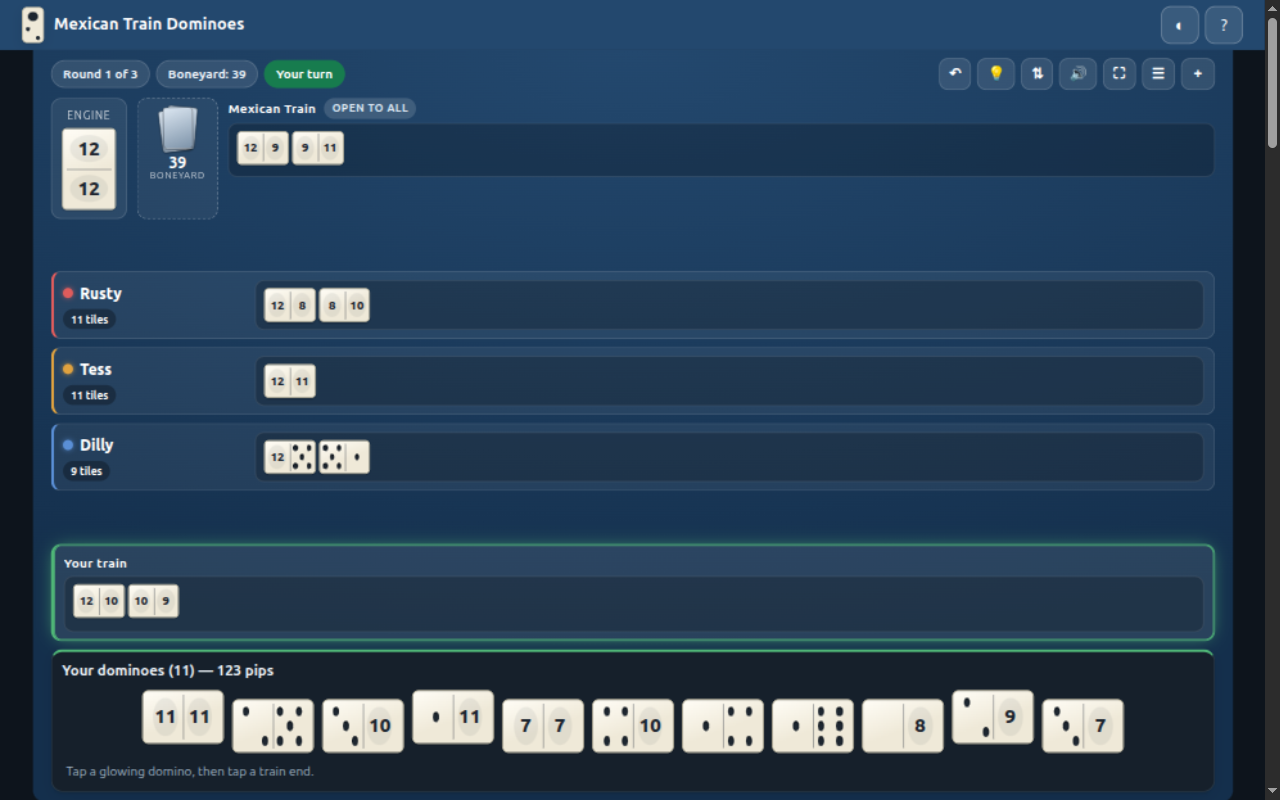
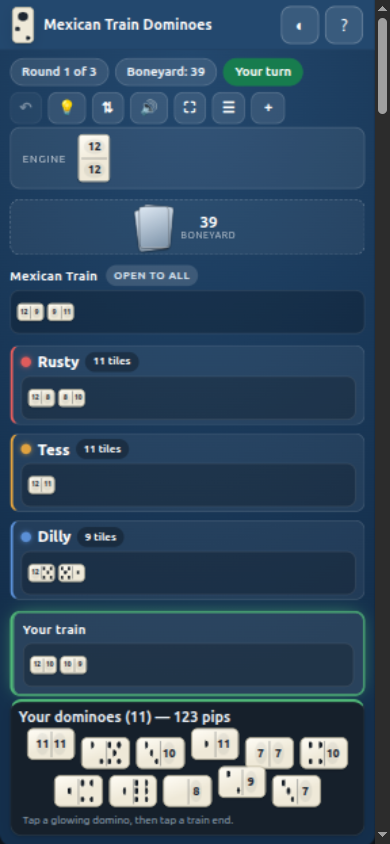
Play Mexican Train online free — no download, no sign-up, no account. Mexican Train is a dominoes game where each player builds a train from a shared starting double and races to empty their hand. It runs entirely in your browser: open the page and play against the computer, or pass one device around for 2 to 4 players on desktop, tablet, or phone.
What is Mexican Train?
Mexican Train is a tile-laying dominoes game, usually played with a double-12 set of 91 tiles. A single double tile — the engine — starts in the center hub. Each player builds a personal train outward from it, and the whole table shares one extra line called the Mexican Train. A round ends when someone plays their last tile. Everyone else counts the pips left in their hand as points, and the lowest total after the final round wins.
The name comes from the long line of tiles, which looks like a train pulling out of a station. House rules differ from table to table, so this version follows the most common setup: the highest double dealt becomes the engine, doubles must be covered, and a train opens when its owner cannot play. You can compare descriptions in the Wikipedia entry for Mexican Train, check rule variants in Pagat's Mexican Train rules overview, or read our complete Mexican Train rules guide.
The engine, the trains, and the boneyard
- Engine: the double that starts the board. Here it is the highest double dealt to any player, and that player takes the first turn.
- Personal train: your own line. Other players can only use it once it is open.
- Mexican Train: the shared line in the middle. It is public for the whole round.
- Boneyard: the face-down pile. You draw one tile from it when you cannot play.
How to play in your browser
- Start a game. The board above deals automatically. Open New Game to change the domino set, opponents, or number of rounds.
- Play on the engine value. The first tile on every train must match the engine number.
- Match an open end. Tap a tile, then tap a glowing train end. You can play on your own train, the Mexican Train, or any train that is open.
- Cover your doubles. A double must be covered with a matching tile immediately. If you cannot, you draw once and the obligation passes to the next player.
- Draw, then pass. With no legal move, draw one tile from the boneyard. If that still does not fit, pass and your train opens.
- Finish first. The first player out scores nothing; the rest count the pips in their hand. Lowest total after 1, 3, or 5 rounds wins.
The step-by-step rules cover setup, the engine, and scoring in full, and you can print a free score sheet for table play.
What is included in this free Mexican Train game
- Four domino sets: double-6 (28 tiles), double-9 (55), double-12 (91), and double-15 (136). With 2 to 4 players you start with 7, 10, 13, or 15 tiles respectively.
- Computer opponents: one to three AI players at easy, medium, or hard. Hard mode plays to win rather than just making a legal move.
- Pass-and-play: two to four people on one device, with a privacy screen between turns.
- Match length: one round for a quick break, three for a standard game, five for a long match.
- Play aids: hint (H), undo (U), tile sort (O), sound (M), and fullscreen (F). Fast mode plays a legal tile with a single tap.
- Auto-save and offline play: the game saves after each move, so you can close the tab and resume later. After the first load it runs without a connection.
Play on desktop, tablet, or phone
The board is built to fit one screen at any size. On a phone you play one-handed with taps; on a tablet or desktop the same layout scales up and every tile stays one click away. Because it is a website rather than an app, it runs in Chrome, Safari, Firefox, and Edge on Windows, macOS, Linux, Android, and iOS — no store, no permissions, no updates.
If you want an app-like experience, use your browser's Install or Add to Home Screen option. The game then opens full-screen with its own icon and still works offline. On desktop, the keyboard shortcuts are U (undo), H (hint), O (sort), M (sound), F (fullscreen), and Esc (pause).
No sign-up, no download: what that means here
Most online domino games ask for an account, an app install, or an email address before you can play. This one does not.
- No account and no email. The game starts as soon as the page loads. There is no login screen and nothing to verify.
- No download. The whole game is HTML, CSS, and JavaScript served from this site. Nothing comes from an app store.
- Saves stay on your device. Progress is stored in your browser's local storage, not on a server. Clearing site data removes the saved game.
- Free, with nothing locked. Every set, difficulty level, and game mode is available from the start.
Mexican Train rules worth knowing
- You must play if you can. Passing is only allowed when you have no legal move, and only after drawing.
- Doubles block the table. While a double is uncovered, no other train can be extended until someone covers it.
- Open trains stay open until their owner plays on them. That is the cost of passing: rivals can dump high tiles on your line.
- The lowest score wins. Winning a round is worth 0 points, but one bad round of heavy tiles can cost you the match.
These match the rules used by the engine above. Variations such as fixed engine rounds, no-draw play, and partner games are covered on the Mexican Train variations page.
Tips that actually matter
- Shed high pips early. A 12–12 or 12–11 left in your hand can decide the match.
- Keep a play for your own train. As long as you can add to your train, it stays private.
- Do not play a double unless you can cover it. Playing and covering in one turn removes two tiles; failing opens your train.
- Use the Mexican Train for orphan tiles. Park numbers you cannot extend instead of opening your own line.
More detail in the Mexican Train strategy guide. Choosing a game for game night? Compare Chicken Foot vs Mexican Train or classic dominoes vs Mexican Train.
FAQ
Can I play Mexican Train without downloading or signing up?
Yes. The game loads in your browser and starts immediately — no account, no email, no install. You can install it to your home screen if you want an app-like icon, but that is optional.
How many dominoes do you start with in Mexican Train?
It depends on the set. With 2 to 4 players, double-6 deals 7 tiles each, double-9 deals 10, double-12 deals 13, and double-15 deals 15. The remaining tiles form the boneyard. This game deals and tracks them automatically.
How does a Mexican Train round end?
Two ways: one player empties their hand and scores 0, or every player is blocked with an empty boneyard, in which case the lowest pip count scores 0. Everyone else adds up the pips left in their hand. Lowest total after the final round wins.
Can two people play Mexican Train on one phone?
Yes. Choose 2, 3, or 4 human players in New Game Settings and pass the device between turns. A privacy screen hides each hand. You can also mix human and computer players, up to 4 in total.
Does this Mexican Train game work offline on mobile?
Yes. After the first load the game runs offline and saves your progress in the browser. On iPhone, use Share then Add to Home Screen; on Android, use Install app.
Is Mexican Train the same as Chicken Foot?
No. Both start from a central double, but in Chicken Foot a double needs three tiles to close and splits the line into a foot shape. In Mexican Train a double needs one tile, and each player builds a single straight train. Our Chicken Foot vs Mexican Train comparison covers the scoring differences.